
Earlier this year, the second edition of the IESE Future Leaders in Sustainability Award (FLSA) took place. The initiative brings together a select group of individuals committed to advancing sustainability and responsible business. More than an award, it is an immersive experience—connecting people, ideas, and action around the systems shaping our future. In this post, FLSA awardee Ángeles Blanco shares her reflections and key learnings from the experience.
This year, I’m honored to have received the IESE Future Leaders in Sustainability Award 2026 and to have attended the Doing Good Doing Well conference in February.
Why I applied for FLSA
My passion for sustainability has deep personal roots. I grew up in rural Galicia, raised in a context where respect and care for resources were embedded in everyday life. Clothes passed down across generations, objects reused and repaired, food gathered directly from the land, and time spent observing and engaging with nature. These circumstances built a lasting sense of interdependence and quietly shaped my values. I later studied Physics and built my career applying AI to high-stakes financial environments, which encouraged my systems thinking and grounded my understanding of responsible business. Earlier work on climate-alignment assessments of credit portfolios also reinforced a critical insight: climate change is a systemic risk amplified by fragmented data, short-term incentives and poorly designed decision-making frameworks. Beyond my current work in AI, I’m increasingly focused on how data infrastructure and systems thinking can drive circularity at scale. At a time when governmental leadership often falls short, businesses must step up to drive systemic change.
Thus, FLSA was a superb threefold opportunity: to stay close to the latest thinking and initiatives in sustainability, to sharpen my ability to align technological rigor with long-term planetary and societal value, and to engage with passionate people who are building at the frontier.
The FLSA agenda
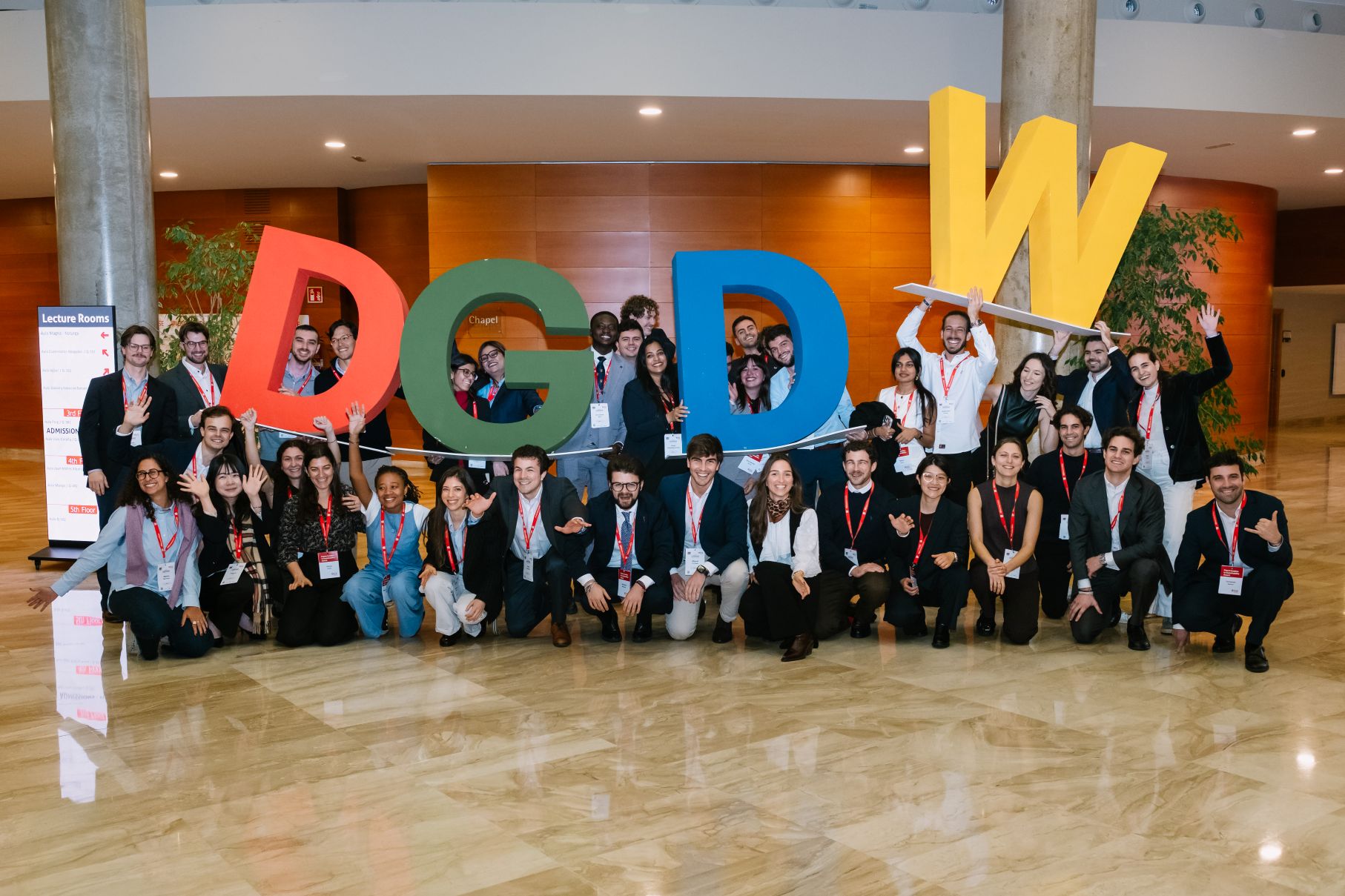
The program was thoughtfully structured over two days. The first afternoon was dedicated to the FLSA group: a campus tour, a welcome session led by Fernanda Accorsi (Director of IESE’s Institute of Sustainability Leadership, another factor that drew me in), a kick-off session, and a presentation by MBA Admissions followed by an outstanding student panel. We also had the chance to sit in on one of the MBA courses, and the day closed with a networking dinner where we got to know each other properly. The second day was spent at the Doing Good Doing Well conference itself, attending the full program alongside IESE students and external participants, and closed with an FLSA-specific session and a final dinner.
The cohort was a genuinely international group of extraordinary people from over 15 countries spanning very diverse backgrounds in different sectors. What stood out was the quality of the conversations, since these were people with strong convictions and real projects behind them, determined to build something that matters.
Highlights from the Conference
Here are some really powerful extracts, and ideas that stayed with me:
• Paul Polman put it bluntly: “I can’t make a profit and be sustainable at the same time” is lazy thinking. We’re suffering from a prisoner’s dilemma, not a technology problem. The future of humanity is not competition; it’s #cooperation.
• Sebastian Kind showed how Argentina reached previously unseen peaks of renewable energy penetration by engineering financial trust structures that made risk measurable. Cascade funds, treasury bonds. They created a new model. Risk was never eliminated, it was simply allocated. “We often believe we need perfect conditions to do things. We don’t. What investors need is the certainty that risk can be measured. (…) If you give investors certainty, capital will flow.”
• In the panel on Blended Finance in action, a particular insight: when you’re talking about raising several millions in Catalytic Capital, a lot of multilateral institutions have a cost of opportunity (they operate in billions). Philanthropic capital and family offices fill this gap, but the ecosystem is complex and opaque. There’s a huge opportunity to make sure that this capital stays focused on impact. Impact finance has its own infrastructure problem.
• Prof. Michael Posner on human rights: the biggest companies have grown bigger while governments have weakened. That creates obligation. And in social media, the need for intervention is not in the content, but in the algorithms at play. AI will only amplify what’s already broken.
• Samuel Kembou, PhD on scaling something that works: “Do not design to scale. Design to fit, design to belong to systems.”
And the common thread can be well summarized in the encouraging words of Sebastian Kind: “Don’t fear complexity, fear inaction. Systems matter more than speeches. Go where the system is broken, where people say it cannot be done. Find the thing that 20 years from now makes you say ‘I built it and it mattered’. When someone tells you it’s impossible it’s just because they haven’t seen it done yet.”
My main takeaway was how consistently the conversations across sessions converged on the same idea: that the real bottleneck is neither technology nor capital, but the design of resilient and collaborative systems that connect them. This is what I’ll carry forward. As the conference theme reads, it’s about “Building tomorrow, together”.
Grateful to the whole team at IESE Business School and the IESE Responsible Business Club for bringing these conversations together, for the wonderful people I got to meet there, and for leaving me inspired.
Written by Ángeles Blanco, FLSA Awardee 2026 (This post is adapted from Linkedin]
Applications for the next edition of the IESE Future Leaders in Sustainability Award will open in November.
Pursue your dream MBA! Take these next steps today: