

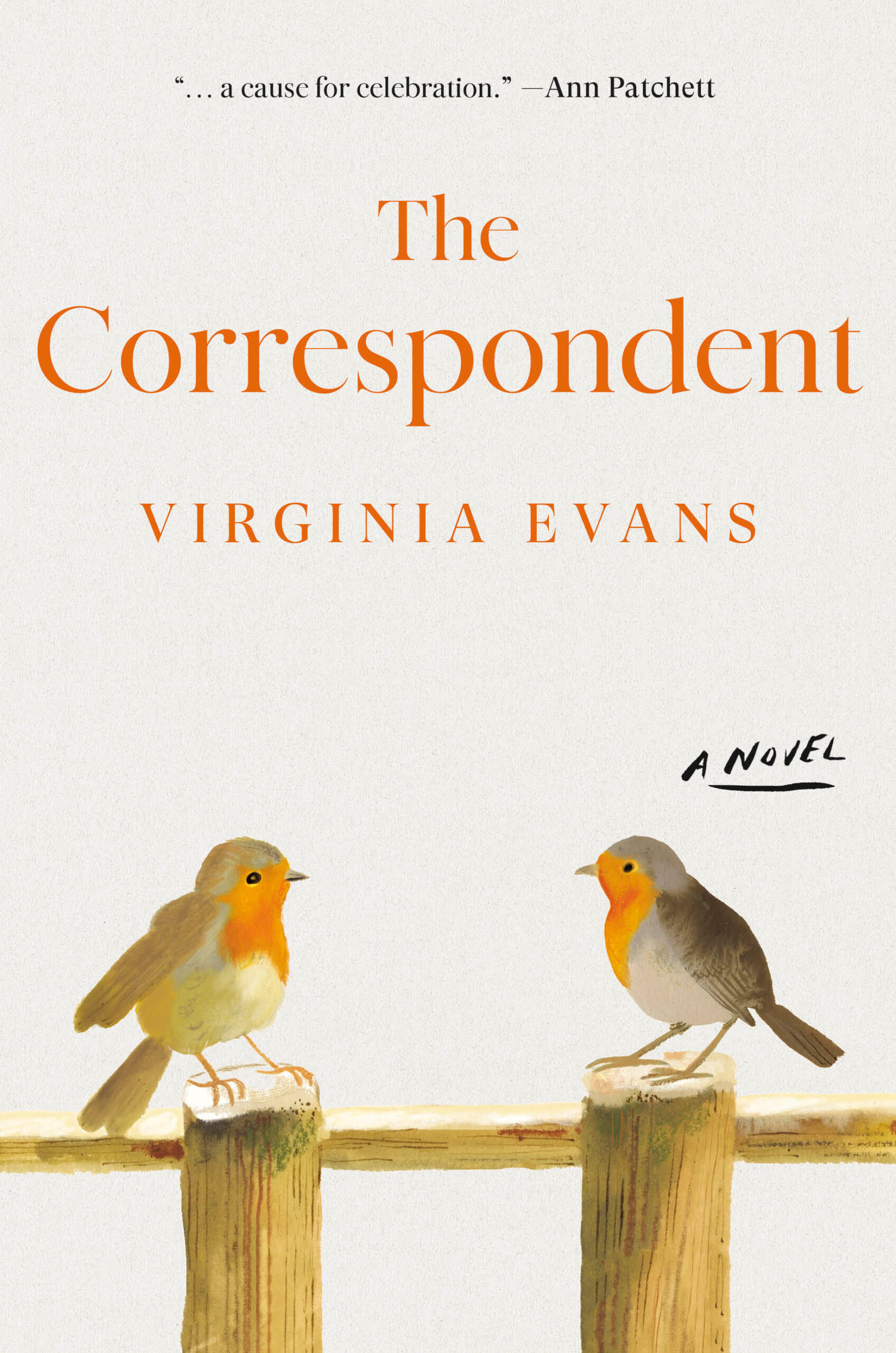
 Virginia Evans’ debut novel The Correspondent has become one of the literary surprises of the past year. The novel follows Sybil Van Antwerp, a retired lawyer living alone in Annapolis. She is the divorced mother of two living adult children and one who died when he was eight. The story is told entirely through the letters and emails sent between 2012 and 2022. Sybil writes to almost anyone. Her recipients include her brother Felix and her lifelong best friend Rosalie, her children, a neighbor, the college administrator who refuses her permission to audit a course, authors Joan Didion and Larry McMurtry, and more.
All the while, she is gradually losing her eyesight, and there are a series of unsent letters written to an unknown recipient. Along the way, an unexpected DNA match with a close blood relative forces Sybil, adopted as a small child, to confront a part of her story she had long kept at arm’s length. The book is funny, prickly and heartbreaking, and it won a PEN/Hemingway Award for Debut Novel as well as the 2026 Women’s Prize for Fiction.
Recommended to me by my wife, I finished it with the feeling that Evans had written, almost by accident, a novel about proximity.
The Resonance of Correspondence
For anyone who has built a life far from where they started, Sybil’s desk will look familiar. Those of us who live across borders spend a lot of time managing relationships at a distance. We schedule calls across time zones, send voice messages to parents, and try to stay part of friends’ lives we mostly see through a screen. The effort is constant, and it is easy to feel that distance itself is the enemy.
In my book, Proximity, I argue that distance is not the problem to eliminate. The real challenge is building proximity: a balancing act between two human needs that pull in opposite directions. We need belonging, the sense of being connected to and accepted by others. We also need difference, the freedom to be distinct, hold our own views, and not dissolve into the group. Too much emphasis on belonging and we conform; too much on difference and we drift apart. Proximity is found in the tension between the two, and it doesn’t require physical closeness or sameness.
Sybil, it turns out, is a master of this balancing act.
Insights from The Correspondent
Three aspects of Sybil’s letter writing have stayed with me.
- Letters as an investment in others. Sybil travels little and lives alone, yet she is anything but isolated. Her letters are a deliberate, almost daily, investment in relationships. She writes not only to family and old friends but also to near-strangers, from bureaucrats to authors she admires. At the end of nearly every letter she writes, she tells her correspondent what she is reading and asks what they are reading. That small ritual is a question that invites a reply and creates a shared reference point across the distance. Belonging here is not a given. It is built, one envelope at a time, through attention and reciprocity.
- Letters as a mirror. Letters also connect Sybil with herself. Writing forces her to slow down, choose her words, and look at her own life from a little distance. She began writing letters because her birth mother had apparently written letters. And she links her lifelong love of clear rules and systems to the early sense, as an adopted child, of not quite fitting in. The unsent letters matter just as much as the sent ones. They are where she works through the grief she has spent the last thirty years holding close to her chest. When the DNA match arrives, correspondence becomes the medium through which she slowly comes to terms with where she comes from, at the very end of her life. This is proximity with oneself: the capacity to hold the different parts of our own story close enough to integrate them, rather than keeping some of them in exile.
- Letters as a space for difference. Sybil is stubborn, cantankerous, opinionated, and her letters give her room to be exactly that. On paper she can formulate a view, defend it, reconsider it, and sometimes change her mind in the next letter. Letters create a protected space where difference can be articulated rather than suppressed. But Evans is too honest a writer to romanticize this. The same distance that lets Sybil speak freely also lets her hide. Her daughter is the one person Sybil can never find the right words for, and some of her most important letters go unsent. The pen can bridge distance but can also become a shield, highlighting the delicate balancing act that achieving proximity often is.
Tools to Achieve Proximity
The lesson of The Correspondent is not that we should all return to pen and paper. Letter writing works for Sybil because it fits her situation: her age, her failing eyesight, her temperament, and a lifetime habit of making sense of the world through words. However, letters are but one tool for building proximity. The book also shows its limits. Some relationships need more than well-crafted words; they need presence, risk and the awkwardness of real-time conversation. Proximity is never the result of a single practice. It comes from a repertoire we adapt to our circumstances.
What else can help us balance belonging and difference across distance? Three tools stand out from my research and experience:
- Rituals of connection. Like Sybil’s reading question, small recurring practices create continuity: a standing weekly call with a sibling abroad, a shared playlist, a team’s Monday check-in that starts with something personal. Rituals lower the cost of staying in touch, and repetition builds a sense of belonging over time.
- Moments of intentional presence. Distance can be bridged remotely much of the time, but not all of the time. Being physically together occasionally, whether at a family gathering, an offsite, or a visit when it really matters, gives remote connection something to draw on. The key is to use those rare moments deliberately rather than leaving them to chance.
- Practices of reflection. Proximity with others depends on proximity with ourselves. Journaling, coaching conversations, long walks, or peer groups of people with similar global lives give us space to notice how we are changing and what we need. For globally mobile people in particular, whose identities shift with every move, this inner work is not a luxury. It is what allows us to show up authentically in our relationships rather than performing the version of ourselves others expect.
For organizations with distributed teams, the implication is similar. Leaders should not rely on a single channel, whether that is video calls, all-hands meetings, or the annual retreat, to create connection. They should build a mix of practices that help people feel part of something while leaving room for them to stay different.
The Links of a Long Chain
Near its core, The Correspondent offers a lovely image: Sybil imagines her letters as links of a long chain, scattered across the world, each carrying a small piece of her story. Most will never be reassembled. Yet together they form a life lived in connection, with others and with herself.
For those of us living between places, that image offers some comfort. We cannot be everywhere, and we cannot close every distance. But we can keep adding links: a letter, a call, a ritual, a visit, a quiet hour of reflection. Proximity is not something we achieve once. It is something we write, and rewrite, over a lifetime.