

What starts as a business idea doesn’t always end up as the business you build. For IESE alumni Sparsh Agarwal and Ernesto Fernandez (both MBA’24), customer conversations led them from an initial idea around EV charging and second-life batteries to Suno, an energy startup that helps commercial and industrial companies reduce their electricity costs through energy management.
The two met during their MBA at IESE, where a shared interest in energy, complementary skills and, as Ernesto puts it, “trust” eventually turned them into co-founders. We spoke with them about finding the right problem to solve, learning when to pivot, building a company in an international environment and the role that IESE and its entrepreneurship ecosystem has played along the way.
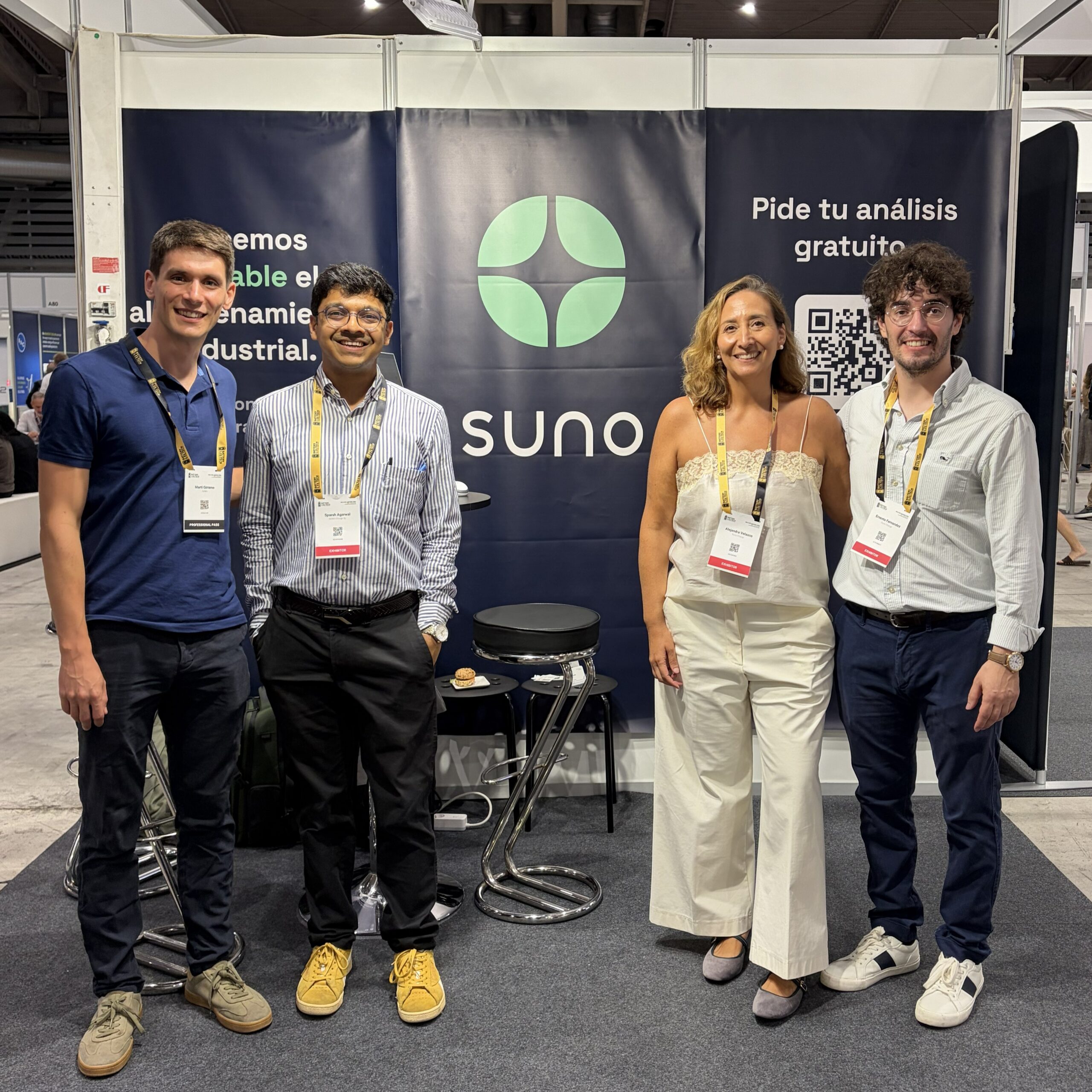
Could you introduce yourselves, share a bit about your backgrounds, and explain what brought you together as co-founders?
Sparsh: I grew up in India, studied industrial engineering in Germany, and spent the majority of my professional career working on industrial automation and energy efficiency projects for a family business based in India. A large part of why I came to IESE was to find a like-minded partner with whom I could build a global business. A mutual friend introduced me to Ernesto, and I shared an early version of my business idea with him for feedback. He felt equally passionate about the vision, we had complementary skill sets, and we were able to build trust through shared experiences during the MBA. That made it easier to embark on this journey together and build Suno after graduation.
Ernesto: I’m Ernesto Fernandez, born and raised in the US. I studied business, supply chain and logistics at Michigan State University. I spent four years at Amazon, the last two on the energy team for Amazon Air, buying sustainable aviation fuel and running carbon accounting. That’s where I saw how much of the energy transition runs on broken processes. I came to IESE with my own idea, then did Techstars Berlin alongside twelve startups. That taught me what building a company really takes, and it told me my idea wasn’t the one. Sparsh was working on something in energy and asked for feedback after my time at Techstars. We spent about a month discussing the opportunity, then spoke to each other’s MBA teams to understand how we worked as the conversation shifted toward becoming co-founders. Trust was the filter.
How did your time at IESE shape your entrepreneurial journey?
Sparsh: The launchpad was the Summer Entrepreneurship Experience, which gave me a low-risk, structured opportunity to put together a team and test a business idea in the real world. The biggest learning there was to quickly and iteratively (in)validate hypotheses and move toward solving a problem that users actually cared about. IESE also allowed me to tailor coursework to the business while it was still nascent. For example, I used one class to analyze a competitor’s financial statements and assess the long-term implications of their chosen business model on their balance sheet, which influenced how we chose to position ourselves from day one. We found our first angel investors, advisors and early adopters all through the IESE ecosystem, and the network continues to be invaluable for recruitment and customer outreach.
Ernesto: IESE has been a huge part of the entrepreneurial journey, and the network is the biggest piece of it. People from the network have helped us connect with industrial clients, and a lot of them have given us feedback expecting nothing in return. Some of our advisors came out of that network, and the friends we made during the MBA have introduced us to their own networks too. What I’d say IESE really brought us is access to a lot of very smart and curious people who want to know more and have a real impact. At the end of the day, business is between humans. Having that IESE background in common really helps.
Many ventures evolve significantly from their original idea. Has your business changed direction since you started it?
Sparsh: We have pivoted significantly from our initial product, industry and business model, all while remaining true to the vision that inspired the idea in the first place. We learned through customer conversations and deals that fell through about the importance of having a simple solution that solved a problem big enough that the user actually wanted to address it. Our initial hypothesis was to integrate end-of-life electric vehicle batteries with EV charging stations, whereas today we help commercial and industrial companies reduce electricity costs through energy management. Our initial solution was designed for stakeholders that didn’t have any urgency, and some hadn’t even faced the problem we were trying to solve. In our current business, we know that an industrial director staring at a six-figure annual electricity bill certainly does.
Ernesto: It’s changed drastically. Everyone tells you you’re going to pivot, but how you do it and what information you act on is what actually matters. We started building hardware – EV chargers integrated with batteries – and built one from scratch. When we spoke to customers, there wasn’t a real need, and everything moved slowly because we weren’t solving something somebody needed solved today. A lot of them kept saying the same thing: instead of using the battery to optimize the charger, can you use it for our own processes and save us money there? That took us from parking lots to industrial and large commercial clients. Our distribution channel has changed the same way, as we keep talking to people with a specific problem set.
The energy sector is undergoing a profound transformation. Where do you see the biggest opportunities for innovation, and what role can startups play?
Sparsh: Energy has traditionally been dominated by large, decades-old conglomerates with resources, thousands of clients and significant institutional backing. That provides the stability and security historically expected of the energy system, but we’re in the midst of a transition that is straining the electric grid, and these companies aren’t adapting quickly enough. A big opportunity is unlocking flexibility connected to the grid, while serving both the end user as well as the system, something that remains largely untapped today. Startups can use their agility to solve this problem and democratize access to clean and affordable energy while still maintaining security of supply and safety.
Ernesto: The biggest opportunity is the amount of data companies now have at their disposal, and what that makes possible. Renewable energy depends heavily on that data, and having it means you can collect it, analyze it, and act on it far faster than before. That’s where startups have a real advantage. The bottlenecks are fewer and you simply have more ability to get things done. On the other side, you have very large companies that have done things the same way for a very long time, and they can’t move at that pace. So the role startups play is pushing the sector toward innovation and greater speed.
Looking back, what have been the biggest lessons from your entrepreneurial journey?
Sparsh: This seems very obvious in hindsight, but the biggest one has been learning to say no. In the earliest days, when we were chasing our first customer, we found ourselves in conversations and opportunities that weren’t aligned with our strategy, but felt like progress: potential customers in geographies that weren’t our immediate focus, MoUs with partners that generated no revenue, features that didn’t move the needle for clients. Saying no to those would have freed up time and resources for the things that genuinely took us forward, and we didn’t do it enough. Now, every time we say no, we come out with more clarity on the aspects of the business we need to prioritize.
Ernesto: The biggest lessons have all come from setbacks. We’ve had them in fundraising, the team, sales, product – basically every single thing. And the only way you get a lesson is if there’s a setback first. What they’ve shaped in us is resilience. You learn to take them with a grain of salt and stay curious enough to learn something or try a different approach, and then you build on top of that. There are too many to call out here, but I’d say if you’re on this journey there will be a lot of setbacks and they’ll come across every vertical. It’s a huge exercise in willpower and grit, and in getting things done in whatever way, shape or form you can.
Building a startup is challenging enough, but you’ve also done it in an international environment. What have been the biggest challenges – and opportunities – of building a business across cultures and markets?
Sparsh: Even though I’ve always found it intriguing to learn about different cultures and languages, it is not easy to show up to a meeting and instill confidence in people while conversing in a language you started learning a couple of years ago. We have had meetings where I wanted to say something but couldn’t get it across cleanly enough in Spanish. It’s something I’m still working on every day. The flip side is that I’ve experienced firsthand the advantages of working in culturally diverse teams. Building a business in a city like Barcelona is a real opportunity to attract talent from across the world and build a team and a culture where people thrive because of their differences rather than in spite of them.
Ernesto: The biggest challenge was starting without a network. Spain is our main market, and neither of us came in with pre-existing relationships here. If we’d been in India, Sparsh would have had his network. In the US or Mexico, I’d have had mine. That’s why IESE mattered so much, because it gave us access to people we could talk to and learn from while we built from scratch. The other piece is learning the culture and the timelines Spain moves by. August is a completely dead month, so you don’t do outbound then. The opportunity is that we’ve been an international team from day one. As we grow the team and the ambition, that stays true, and it’s cross-cultural and cross-market by default rather than by effort.
What advice would you give to anyone who is thinking about starting a business?
Sparsh: Talk to people who are facing the problem instead of building a business model canvas or financial projections in Excel. Those are merely hypotheses that need to be validated in the real world. Early on, all your presentations and projections will become obsolete within a matter of weeks, so don’t spend all your energy building those. Instead, dedicate that time to talking to actual customers, listening to their objections and collecting real feedback.
Ernesto: Pick something you’re passionate about or know a lot about. If you’ve lived the pain yourself, even better. If you haven’t lived it, then pick a market where you already have a lot of contacts. That way you can go verify the pain points with real people, across enough of them that you actually learn something. Those are the two big ones. The idea itself will probably change, but the people, the context and the problem stay. And finding the real pain points takes a large network and genuine access to it. You need people who will talk to you openly, without gating information or being cautious about what they say. That’s much harder to get in a market where you’re a stranger.
Speed round
What’s your favorite way to spend your free time?
Sparsh: Experimenting in the kitchen with a recipe I’ve never tried before, or playing squash.
Ernesto: Getting up to date on all the new tech trends, and going to the beach.
What are you reading, watching or listening to these days?
Sparsh: Ted Lasso’s new season on Apple TV.
Ernesto: Reading Awaken the Giant Within – a great book for business and life.
What’s one thing that always gives you energy?
Sparsh: Talking to my dad – he’s always brimming with ideas and optimism.
Ernesto: Coffee.
What’s your favorite place in the world?
Sparsh: Bremen, the city where I spent my most transformative years.
Ernesto: Any mountain for snowboarding! But if I had to pick, the Alps.